The model is the easy part
01 / ProblemEveryone has the same AI
Every founder I talk to has access to the same models I do. Same chat app, same coding agents, same price. Intelligence is a commodity now.
So why do most AI projects inside real businesses stall after the demo?
Because the demo was never the hard part. The hard part is getting an agent to do a real job, inside a business that already runs on spreadsheets, bank exports and people’s habits, without breaking anything. That job has a name: the forward-deployed engineer, or FDE. The role started at Palantir, where engineers sat inside a client’s operation, learned how the work was really done, and built around it.
I didn’t set out to become one. I set out to stop doing my own rent bookkeeping.
02 / AgitateThe documented process is never the real process
On paper, my rental bookkeeping is simple. Tenants pay rent. I mark it in the sheet.
In reality, a bank statement arrives. Every payment description is free text, typed by the tenant: sometimes a unit number, sometimes a phone number, sometimes a name, in Cyrillic or Latin, sometimes the unit glued straight onto another word. Some people pay rent and utilities in one transfer. Some pay a little over. Some pay part. Half the columns in my sheet are formulas linked to a master tab, so writing the “obvious” cell quietly breaks next month.
None of that was written down anywhere. It lived in my head.
This is where AI projects die. Someone gives a model the documented process, gets a beautiful demo, and the first real statement breaks it. Then the owner stops trusting it, and it never gets used again.
03 / SolutionAudit, redesign, evals, deployment
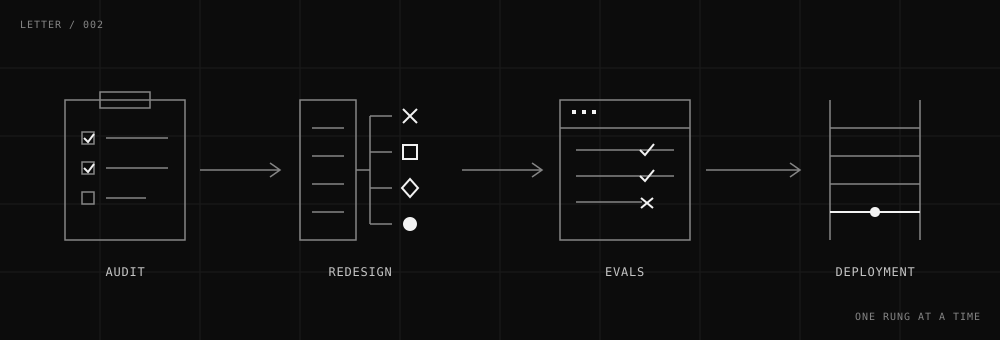
What finally worked was the loop FDEs use: audit the workflow, redesign it, prove it with evals, then deploy it with gradually more autonomy. Each stage earns the right to the next.
1. Audit: map the real work.
I wrote down every step I actually do, and every exception. Nothing gets automated yet. First you see the work.
Most of what I found wasn’t in any document. It was habit.
2. Redesign: sort the process before you automate it.
Then every step gets one of four answers: delete it, plain code, agent, or my decision.
- Reading the statement file is plain code. No AI needed.
- Matching a messy description to a unit is the agent: first by unit number, then phone, then name.
- Deciding what to do with a partial payment stays with me.
- Writing to the formula columns gets deleted from the job entirely. The agent is never allowed to touch them.
That last bucket matters most. Deciding where intelligence doesn’t belong is half the work.
3. Evals: turn “it seems right” into evidence.
An agent that’s right most of the time is a liability if you can’t tell which time is which. So every run has to show its work:
- Each payment is classified as rent, utilities, late fee, or partial, against the amount it should be.
- Anything that doesn’t fit cleanly gets flagged for me instead of guessed.
- After writing, the agent reads every cell back and checks it against what it proposed.
- If it couldn’t read the sheet, it’s not allowed to tell me “all clear.” Ever.
The goal isn’t a perfect agent. It’s an agent whose mistakes are visible.
4. Deployment: on top of what already exists.
I didn’t migrate to a new system. The agent works on the same Google Sheet and the same bank export I already used. And it started at the bottom of the autonomy ladder:
- It proposes the entries. Nothing is written until I reply “Apply.”
- It drafts tenant reminders. Nothing is sent until I approve each one, and an approved message is sent once and never retried.
As the record holds, the agent moves up a rung. Not before.
04 / OutcomeA system I trust, and a skill that transfers
Bookkeeping was day one. The same loop now covers eight workflows in my building, from reminders and complaints to maintenance, leases and move-outs. I’ve written each one up on Builds.
But the real outcome isn’t the rental agent. It’s the method. Audit, redesign, evals, deployment works on an invoice queue, a clinic’s bookings, or a sales pipeline, because every business has the same gap between the documented process and the real one.
That’s the skill the next decade pays for. Not prompting. Not picking the best model. Taking a commodity intelligence and deploying it into a real business so the owner actually trusts it.
I’m building a course around exactly this loop, with Claude Code for the building and an agent team for the running and the proof. More on that soon.
As the team at Varick puts it: do the job before you have the title.
— Anand